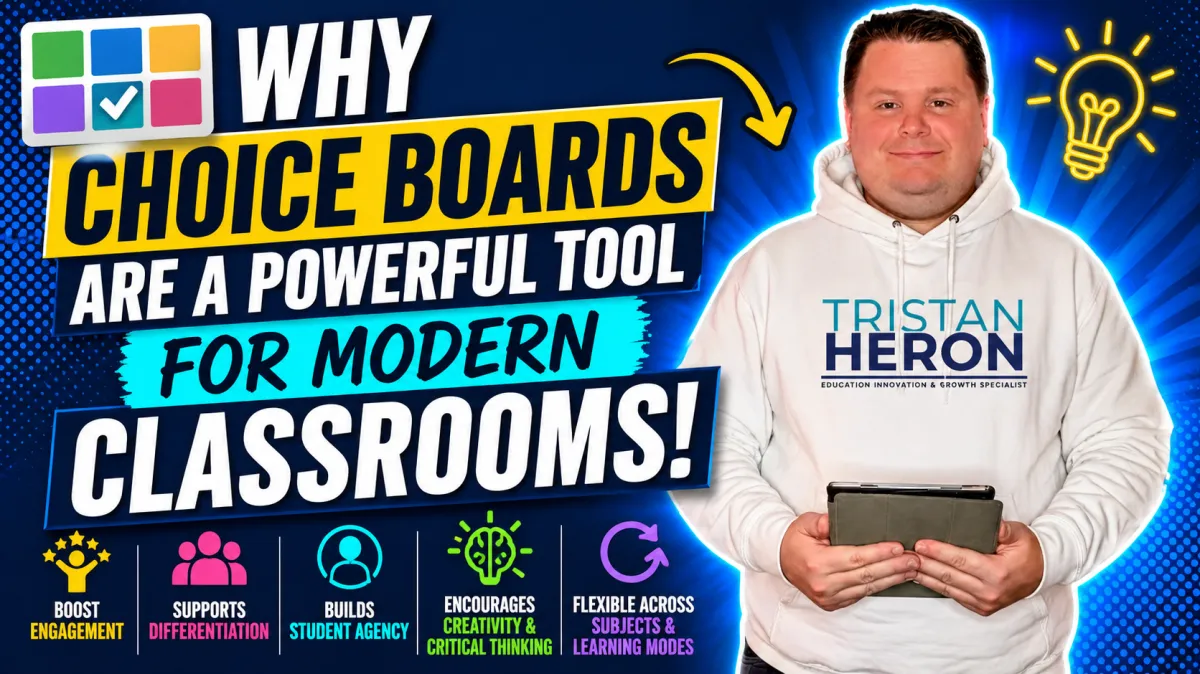
Why Choice Boards Are a Powerful Tool for Modern Classrooms
If you are looking for a practical strategy that boosts engagement, supports differentiation and gives students more ownership of learning, it might be time to revisit choice boards.
At Evolve EdTech, we love tools and strategies that are simple to implement but high impact for learners. Choice boards are one of those rare classroom approaches that can transform learning without requiring expensive software or a complete teaching overhaul.
They are straightforward in concept.
But powerful in practice.
What Is a Choice Board?
A choice board is a grid or menu of task options linked to the same learning goals.
Students select from a range of activities to decide how they will engage with content, practise skills or demonstrate understanding.
That might include options such as:
Creative tasks
Written responses
Digital presentations
Problem-solving challenges
Collaborative activities
Reflection tasks
Research tasks
Hands-on creations
The learning goal stays consistent.
The pathway becomes flexible.
And that shift matters.
1. Student Agency Increases Motivation
One of the biggest strengths of choice boards is student agency.
Instead of every learner completing the exact same task in the exact same way, students have a say in how they approach their learning.
That sense of ownership can significantly improve:
Motivation
Effort
Buy-in
Independence
Pride in work
When students feel trusted to make choices, they often engage more deeply.
Sometimes the difference between compliance and commitment is simply having a voice.
2. Differentiation Becomes More Manageable
Every classroom contains learners with different strengths, interests and readiness levels.
Choice boards help teachers respond to that diversity without creating entirely separate programs for every student.
A single board can include tasks with:
Different levels of complexity
Varied support structures
Creative or analytical pathways
Individual or collaborative options
Written, visual or spoken responses
That means students can access learning in ways that better suit their needs.
And teachers gain a more sustainable differentiation strategy.
3. Creativity and Critical Thinking Grow
When students choose how to apply their learning, something powerful often happens.
They begin to think more deeply about process, audience and purpose.
Instead of simply following one set path, students may:
Solve problems creatively
Evaluate the best way to present ideas
Compare options
Justify choices
Build original responses
Choice encourages thinking.
And thinking drives learning.
4. Works Across Any Subject Area
Choice boards are incredibly flexible.
They can be adapted for almost any learning area.
English
Character analysis
Creative writing
Podcast reflections
Visual theme posters
Mathematics
Real-world problem solving
Video explanations
Maths games
Challenge questions
Science
Experiment design
Infographics
Concept demonstrations
HSIE / Humanities
Timeline creation
Debates
Source analysis
Research presentations
PDHPE / Creative Arts
Fitness challenges
Reflection journals
Design tasks
Performance planning
That versatility makes them valuable across year levels too.
5. Great for Digital Learning Environments
Choice boards also work beautifully in blended, face-to-face or remote settings.
Teachers can build digital versions using tools such as Google Slides, Canva or Google Classroom.
Students can click tasks, submit work and navigate options independently.
Final Thoughts
At Evolve EdTech, we believe the best strategies often make learning feel more human.
Choice boards do exactly that.
They move learning from compliance to ownership.
From one-size-fits-all to flexible pathways.
From passive completion to active investment.
And that shift can make all the difference.